
Narwhal tusks grow in a distinctive helical structure because of the underlying molecular-scale arrangement of mineralised collagen. The finding offers a new example of how microscopic structural patterns drive larger scale biological functions.
The narwhal’s tusk is the only straight tusk found in nature and has fascinated people for centuries, in part because of its association with the unicorn myth. This protruding tooth can be more than two metres long and features a characteristic left-handed spiral.
Now, an international team of researchers has combined multiple imaging techniques – including x-ray diffraction, small-angle x-ray scattering and birefringence microscopy – to map the structure of the narwhal tusk across several scales.

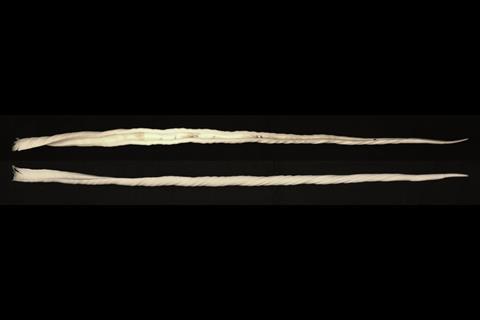
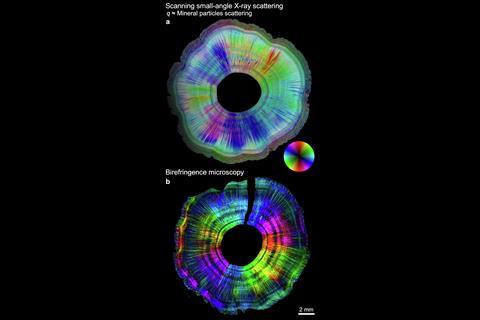
They found that its macroscopic chiral structure originates from two opposing helical arrangements of mineralised collagen: one in the thin outer layer of cementum that covers the tusk, and one in the inner layer of dentine.
The opposing helices are believed to cancel out twisting forces in early stages of growth, enabling the tusk to grow straight. The researchers behind the work suggest that the motif could serve as inspiration for design of bioinspired composite materials with engineered mechanical properties. However, the team also notes that further studies will be needed to understand how the tusk is formed during a narwhal’s development.














No comments yet