
Rebecca Trager meets a cross-disciplinary team investigating an ancient way to make yoghurt, which involved a trip to a tiny Bulgarian village
An age-old yoghurt recipe has united microbiologists, ecologists, anthropologists, food scientists and chefs in a project to uncover why ants make surprisingly good milk fermenters.
The interdisciplinary team duplicated a yoghurt recipe, once common across the Balkans and Türkiye, and discovered that ants produce formic acid, which kickstarts milk coagulation. Their mouths also carry lactic and acetic acid-producing bacteria that sour the yoghurt. On top of that, the ants contribute proteases – enzymes that give the yoghurt what the researchers call ‘a pleasing mouthfeel’.

The project began about four years ago, when several parallel initiatives merged. Biologist and ecologist Robert Dunn, now senior vice provost for interdisciplinary programmes at North Carolina State University in the US, helped bring them together.
About a year later, microbiologist Leonie Jahn joined the effort. She leads a team at the Technical University of Denmark’s Novo Nordisk Foundation Center for Biosustainability. Her involvement followed conversations with Diego Prado Vásquez, then a researcher and chef at Copenhagen’s Alchemist restaurant, and Nabila Rodríguez Valerón, a former scientist at Alchemist who now heads flavour fermentation at Summ Ingredients in Denmark.
With ants we got a very cheesy and buttery aroma
‘We were collaborating on several different topics, and had done really delicious and fascinating ferments, and I was interested in studying the microbiology and underlying biology that explains flavour and elucidates the underlying fermentation principles,’ Jahn recounts.
Curious about ants
Jahn, whose work focuses on developing more environmentally friendly starter cultures and fermentation processes, had just finished reading Sandor Katz’s book The Art of Fermentation and was intrigued by its mention of using ants to start yoghurt fermentation. ‘I thought it was super-interesting that there was a link to this traditional practice and this gastronomic practice, and was really curious about the microbiology,’ she states.
Knowing Dunn’s expertise in ants and fermentation, Jahn shared the idea with him. He was already familiar with the tradition of using ants to make yoghurt and had spoken with anthropologist Sevgi Mutlu Sirakova about a possible collaboration. Sirakova, a PhD student at Ludwig Maximilian University in Munich in Germany, was researching fermentation practices and the migration of foodways – the cultural, social and economic practices surrounding food production, preparation and consumption.
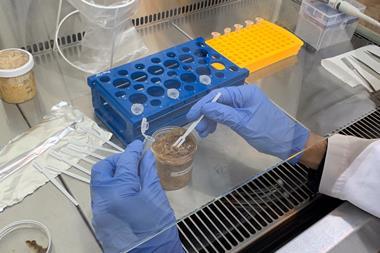
At the time, Dunn was also part of a team that had just hired Veronica Sinotte, an assistant professor of food microbiology and fermentation at the University of Copenhagen, to study the practice of making ant yoghurt more in depth to study the practice making ant yoghurt more in depth.
Having been interested in using ants in food since he was a graduate student about a decade earlier, Dunn began to pull them all together. ‘I am often just a hub that connects great people and also acts as a bit of a translator between anthropologists, chefs and microbiologists,’ he tells Chemistry World.
Valerón, who completed a PhD last year in gastronomic science, says she and the chefs at Alchemist had been working with ants and milk to extract aroma compounds for dishes made with insects. She recalls that suddenly, after eight or 10 hours of refrigeration, the milk took on the texture of yoghurt with distinct aromas.
‘When you coagulate milk with acid you get just the milk without any extra aroma, but with ants we got a very cheesy and buttery aroma that didn’t come just from the acid coagulation,’ Valerón explains. ‘Normally the pH of yoghurt is below 4.5 but this yoghurt was above 4.5, so obviously something else is working here in the final product, and we thought maybe it had to do with microorganisms.’
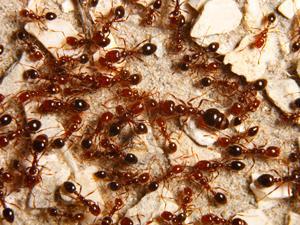
Vásquez, who was head of R&D at Alchemist at the time, and Esther Merino, who worked at the restaurant producing and developing fermented drinks as well as craft spirits, went with the Copenhagen University team to the forests of Denmark to hunt for live ants that could be used in university’s lab studies and eventually in Alchemist dishes.
Fieldwork in Bulgaria
After analysing the ants in the lab, Sirakova helped organise a field trip to her village of Nova Mahala in Bulgaria, in 2023. She brought with her a subset of the team, including Sinotte and David Zilber, a food scientist at Novonesis – a Danish biosolutions company that produces industrial enzymes and microorganisms.

Sirakova had lived in Nova Mahala until age nine, when her family immigrated to Türkiye. Yoghurt was a food staple in the village because most people owned cows and sheep, and it was a way to preserve milk. ‘My grandmother, who passed away a few months ago, was the first person to tell me they used ants to make yoghurt,’ Sirakova recounts. ‘She remembered that from her childhood.’
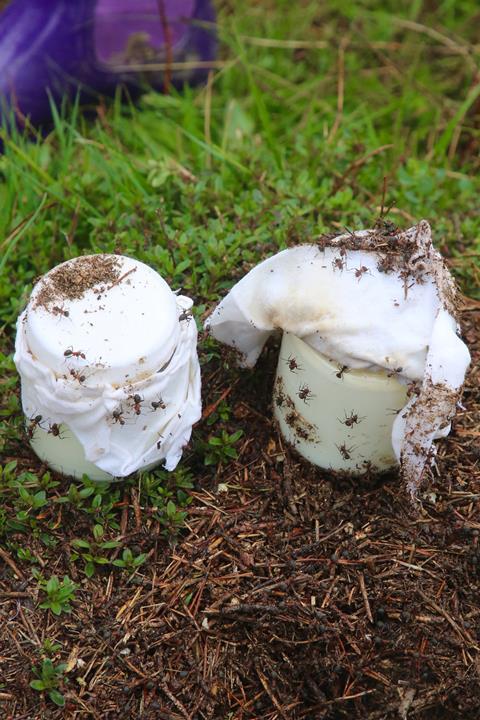
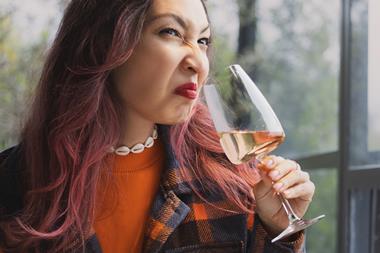
Guided in the ancient practice by Sirakova’s great uncle and members of the local community, the researchers collected red ants from local forests and dropped four whole ones into a jar of warm milk, which they buried in an ant mound to ferment overnight. By the next day, the milk had started to thicken and sour. The researchers who tasted the final product described it as having a rich flavour that was slightly tangy, herbaceous and reminiscent of ‘grass-fed fat’.
Fine dining
Successfully recreating the ancient recipe – both in Bulgaria and in the Copenhagen lab – inspired Alchemist, a two-Michelin-star restaurant where dinner starts at DKK5400 (£636), to put its own spin on the results. The team created menu items like yoghurt ice-cream sandwiches, mascarpone-style cheeses with a pungent tang and cocktails clarified with a milk wash.
Such traditional ferments are much more microbially diverse and can contain up to 20 different microbial strains, according to Jahn. By comparison, modern industrially-produced yoghurt is usually made with just two bacterial strains. This makes it easily reproducible but means there is a much narrower flavour profile.
Natural microbial communities are also much more resilient. For example, phage infections can kill a starter culture. But having many different strains makes it is more stable and also produces richer flavours, Jahn says. Consuming more complex microbial foods may also be advantageous from a health perspective, she adds.
The study’s coauthors have different takeaways from the project and various ideas about next steps. Dunn, for example, wants to better understand how many of these lactic acid bacteria are present in the mouths of different ant species and how they could be useful for culinary purposes.
‘We are humans that know and like each other so this group will stay connected,’ Dunn states. He notes that those involved in the study regularly meet virtually and with other scientists from around the world who are interested in food fermentation, and suggests this forum, and these connections, will spawn new and innovative research projects.
The success of such global, interdisciplinary studies depends on collaborators with very different expertise and goals building trust among one another, says Dunn. ‘It is harder to be a human than to be a scientist, and in a project like this there is a lot of being human involved since it takes longer and has many different objectives,’ he concludes.
References
V Sinotte et al, iScience, 2025, DOI: 10.1016/j.isci.2025.113595








No comments yet