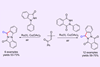
Elsevier is to use AI technology developed specifically for chemistry to extract and curate information such as images, drawings and reaction schemes from scientific publications and patents for its chemical database and search engine, Reaxys. It claims that substance information from images in patents and journals is captured far more quickly, accurately and at far greater scale than was previously possible.
The technology developed by LG AI Research combines molecule detection, reaction-diagram parsing and optical chemical structure recognition (OCSR) in a single model. Called MolMole, it can extract machine-readable structures from images of chemical structures in scientific publications.
‘Every hour a chemist spends deciphering figures or images to see what has already been made is an hour that could instead be spent on chemistry discovery,’ says Mirit Eldor, managing director, life sciences, at Elsevier. ‘Our partnership with LG AI Research gives that time back, lifting more chemistry out of the image and into Reaxys – curated, searchable and ready to act on. A structure buried in a figure should be evidence rather than a dead end.’
LG AI Research claims its technology outperforms its competitors at extracting chemistry from a full document page. To ensure accuracy, each extraction from a scientific publication is validated against existing Reaxys benchmarks before it goes live. The full pipeline has undergone rigorous testing across Elsevier’s data and workflow tools before wider use, it adds.
‘We see a range of novel, partially improved AI models that compete for extracting chemistry with ever increasing quality,’ says Lutz Weber, co-founder of MolGenie a German software company. ‘Given this great progress it is not astonishing that the data curation team of Elsevier has adopted one of those derivative methods such as MolMole. This should give curators at Reaxys a much higher productivity when compared with a fully manual curation.’ However, there are still challenges, he adds. For example, the extraction of metal–organic complexes or metal–organic frameworks is not yet possible.
Weber notes LG’s method ‘unfortunately’ can’t be tested independently as the source code isn’t available and there’s no free webpage or service that allows for image-to-structure conversion. ‘Thus, the reported superior testing results when compared with Decimer or MolScribe [similar, open access tools] cannot be validated. The paper also only appeared as an unreviewed arXiv publication.’
‘Plausible numbers, a genuinely valuable idea and no way for an independent party to check either of them,’ says Christoph Steinbeck, an analytical chemist at Friedrich-Schiller-University Jena in Germany, whose team is developing Decimer. ‘The results cannot currently be reproduced as the model has not been published. And what was released is not open in any useful sense: it carries a [licence], which bars commercial use and forbids derivative works. For a benchmark that is a strange choice. It excludes much of the industry that would most want to measure against it, and it means no one may publish a corrected or extended version of the ground truth.’
No comments yet